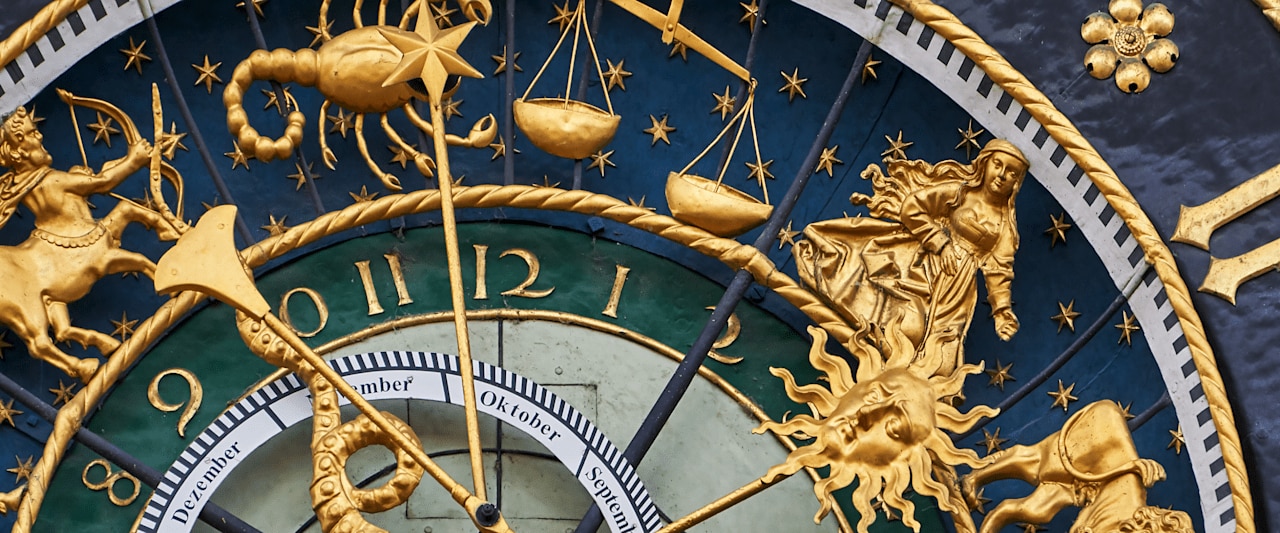
Time itself has many more dimensions to consider
The Watch Edit: Masters of Time by DFS
Beyond the basic time measurement divisions of hours and minutes that we consult daily, there are numerous other aspects to the passage of time to consider, many of which have been ingenuously incorporated into wristwatches. Some, such as calendar functions, have practical applications, whilst others, such as moon phases, tend to merge the artistic and technical nature of watchmaking into these miniature marvels. Allow us to take you on an exploration of the fascinating complexity that these seemingly straightforward functions entail.

There are many more dimensions to time than the hours and minutes
We may take for granted that watches tirelessly show us the hours, minutes and seconds, but the watch movement that enables this on a mechanical or electromechanical basis is quite complex albeit well understood through centuries of development. It was natural that we would seek to extend this to longer intervals, from days and dates to weeks, months and even years. This leads to a significant increase though in complexity, especially since these longer intervals have exceptions that need to be considered: months are not exactly divided into the same number of days, not to mention leap years, all the result of a certain amount of rounding required in order to obtain a usable approximation of the observable passage of time. As always, watchmakers must decide how best to balance the usability of the timepiece with its complexity. A perpetual calendar, such as the Jaeger-LeCoultre Master Grande Tradition Quantième Perpétuel, manages to track all these exceptions over the course of a four-year period, all mechanically coded within its highly developed caliber. The wearer therefore only needs to think about providing sufficient power, either through its automatic winding system or through winding the crown on a regular basis. However, some care does need to be given to setting the time and the calendar, as there are literally hundreds of parts at play, and they need to be carefully handled.

An early pocket watch indicating solar and sidereal time
To make this complexity more manageable, there are annual calendars, as seen with the Glashütte Original Panomatic Calendar. Its mechanism takes the months into account, except for the leap year; presuming it is running continuously, the wearer only needs to make an adjustment at the end of the month of February, every four years. That seemingly small difference has a significant impact by reducing the complexity of the movement and reducing the chance of inadvertent settings, but only slightly. If one is willing to remember to adjust the calendar once a month though, the complete calendar bridges the gap between a simple date and the annual or perpetual calendars, as it will give you the same indications with the only proviso being that the date needs to be adjusted at the end of every other month, as its mechanism is built to consider each month as having 31 days. Intrinsically you may want the full functionality of the perpetual calendar, but one must also consider that its complexity does impact its price, which will rise commensurately.

Calendars and moonphases have always lent a wider perspective to time
Many of these calendars will also indicate the moon phase, a function that perhaps few wearers will ever adjust as we would be hard pressed to say intuitively what the actual moon phase is on any given day. This complication also harkens to an era where people were more keenly aware of the seasonal aspects of their lives and perhaps when we were less surrounded by the bright lights of the big cities and turned to the skies to see our astral neighbor illuminating our nights. However, this interval is one of the most challenging to design with a high degree of precision, as it does not fall neatly at all within our predefined intervals of days, hours and minutes. A full explanation of moon phases from an astronomical perspective is certainly fascinating to those so inclined in its mathematical implications; suffice it to say that we have also tended to approximate a full cycle of the moon’s phases to 29.5 days, which may seem precise, but it means that after only a day, the moon phase display on the watch is already off by 30 seconds, adding up to a full day’s difference in two and a half years. Certainly nothing to be concerned about, but watchmakers are all about precision, and many have devoted considerable thought to improving this aspect. With the impressive Bovet Recital 26 Brainstorm, the moon phase is brought to the fore with its three-dimensional hemispheric moon, beautifully hand engraved and allowing you to see the moon phase as observed from the northern and southern hemispheres simultaneously, with a considerably higher degree of accuracy which only requires a correction of one day after 122 years. Bovet has also included another measurement with the universal time display, graduated into the 24-hourly time zone divisions indicated by a major city in each, with an added nod to its nighttime applications as both the moon and the universal time glow with a luminous display in the dark.

Mankind has always sought to interpret and measure the movement of stars over time
These expressions of various divisions of time in the form of magnificent timepieces are a fascinating view on how our lives are impacted by them. We may tend to be focused on the most granular hours and minutes of each day, but through these watches we can take a step back and appreciate the flow of time on a larger, more philosophical scale.
